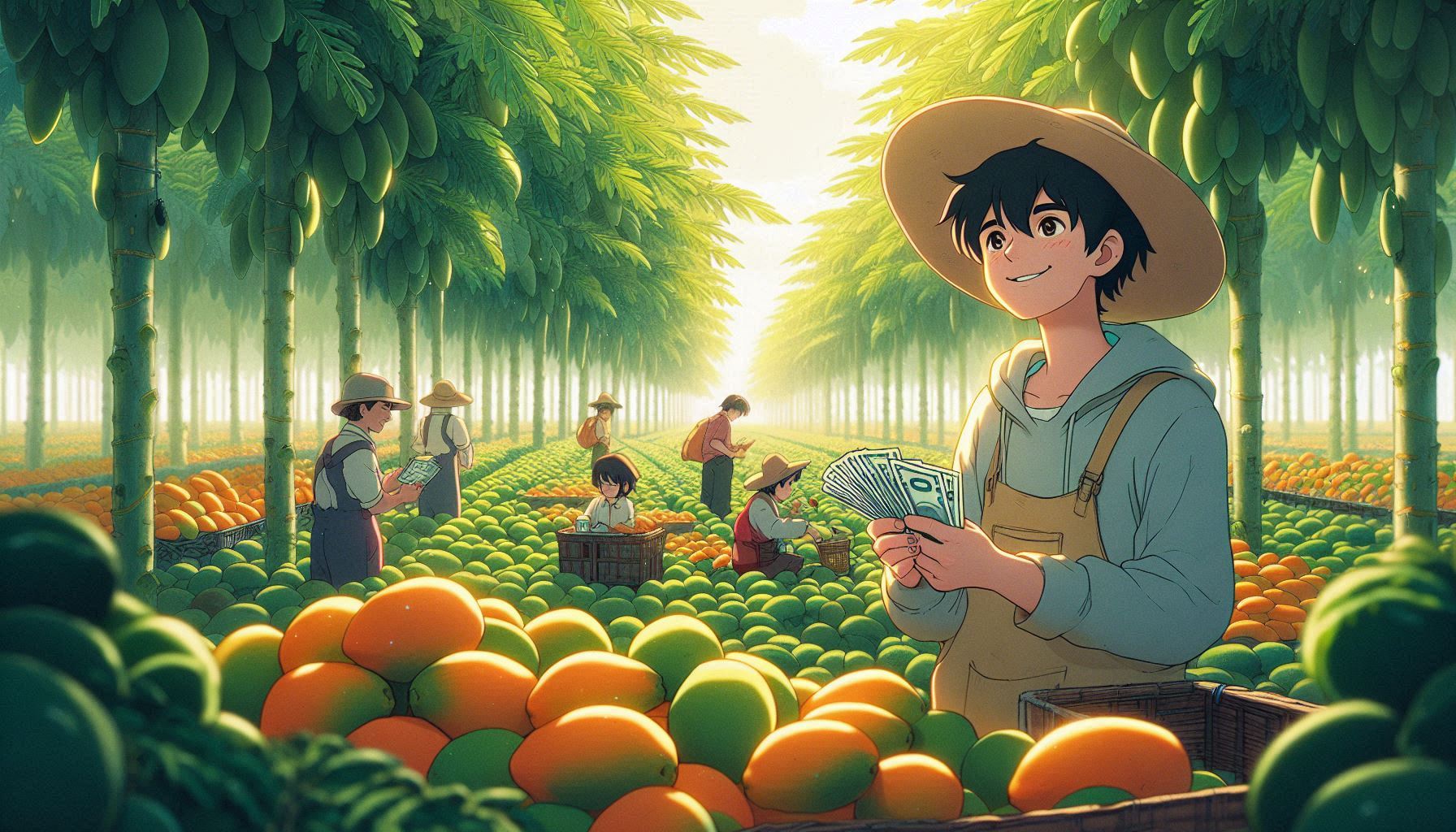
Introduction:
Papaya (Carica papaya) is one of the most profitable tropical fruits for commercial agriculture. With high market demand throughout the year, it provides quick returns compared to other fruit crops. Papaya farming is suitable for big farms as it allows large-scale production, multiple harvests, and excellent profit margins. In this guide, we will cover step-by-step techniques for maximizing yield and profit, including approximate earnings for 1 hectare in a year.
Ideal Environment for Papaya Farming:
Papaya grows best in tropical/subtropical climates with temperatures between 22°C–28°C. It prefers well-drained sandy loam soil with pH 6–7.5. Adequate sunlight (6–8 hours/day) and moderate rainfall (1000–1500 mm annually) are essential. Big farms should have irrigation systems to ensure year-round water supply.
1️⃣ Selecting High-Yield Papaya Varieties
For commercial farming, choose high-yielding, disease-resistant varieties like:
- Red Lady: High fruit quality, fast growth.
- Coorg Honey Dew: Sweet taste, large fruits.
- Honey Dew / Pusa Delicious: Popular in urban markets.
Select healthy saplings or tissue-cultured plants with strong roots and thick stems. Tissue-cultured plants ensure uniform growth, early flowering, and disease resistance.
2️⃣ Land Preparation
- Clear land of weeds and debris.
- Plow 2–3 times for aeration and smooth surface.
- Form raised beds or ridges for drainage, especially in heavy rainfall areas.
- Mix well-rotted organic compost or farmyard manure into the soil to improve fertility.
3️⃣ Planting and Spacing
- Maintain 2–2.5 meters between plants and 2.5–3 meters between rows for commercial farms.
- Dig pits of 45–50 cm depth and width, fill with soil + compost mixture.
- Plant saplings carefully; water immediately after planting.
- For year-round production, stagger planting in blocks so that some trees flower and fruit at different times.
4️⃣ Irrigation Management
Papaya requires regular water supply, especially in the first year. Drip irrigation is highly recommended for big farms:
- Ensures uniform water distribution.
- Saves water and reduces fungal disease risks.
- Water 2–3 times per week depending on weather and soil moisture.
5️⃣ Fertilization and Nutrient Management
- Apply NPK fertilizers based on soil test (common: 20:10:10).
- Side-dress with nitrogen every 2–3 months for leaf and flower growth.
- Use organic compost or vermicompost to maintain soil health.
- Mulching helps retain moisture and suppress weeds.
6️⃣ Pest and Disease Management
- Common pests: Fruit flies, aphids, mealybugs.
- Common diseases: Papaya ring spot virus, powdery mildew, root rot.
- Use organic pesticides and neem-based sprays for pest control.
- Ensure proper spacing, pruning, and drainage to minimize disease spread.
7️⃣ Pruning and Flower Management
- Prune old or damaged leaves regularly to allow sunlight penetration.
- Remove male plants if planting from seeds; tissue-cultured plants are usually hermaphrodite and produce fruit early.
- Staggered pruning can help extend flowering and fruiting season, increasing year-round yield.
8️⃣ Harvesting Papaya
- Papaya trees start fruiting 6–9 months after planting.
- Harvest fruits when skin starts turning yellow for better taste and market acceptance.
- Large farms should harvest every 10–15 days during peak season.
- Proper handling avoids bruising and maintains quality.
9️⃣ Post-Harvest Handling and Storage
- Clean fruits gently; avoid mechanical damage.
- Store in cool, ventilated areas.
- Papaya can be sold fresh, or processed into juice, jam, or dried slices for value addition.
🔟 Approximate Profit Estimation (1 Hectare, Big Farm, in USDT)
- Planting density: 1,600–2,000 plants per hectare
- Average yield: 25–30 tons per hectare/year
- Market price: 0.48–0.72 USDT/kg ($40–60/kg)
- Gross income: 12000–21600 USDT/year per hectare
- Costs (saplings, fertilizers, irrigation, labor): Approx 3,600–4,800 USDT/year
- Net profit: 8,400–16,800 USDT/year per hectare
With staggered planting, some farms can produce year-round, ensuring continuous income and higher returns. Value-added products (papaya juice, powder, or dried fruit) further increase profitability.
Conclusion:
Papaya farming is a high-return, long-term crop suitable for big farms. By choosing high-yielding varieties, proper land preparation, irrigation, fertilization, pruning, and post-harvest management, commercial farmers can maximize profit and achieve year-round production. With careful planning and management, 1 hectare of papaya can earn 8,400–16,800 USDT in the first year, making it one of the most lucrative fruit crops for commercial agriculture.