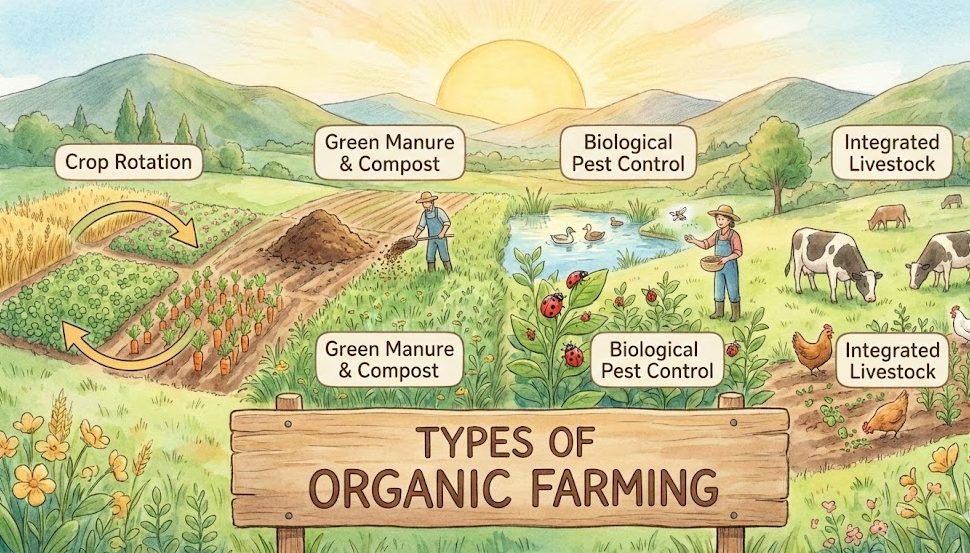
Introduction
Organic farming is practiced in different ways depending on land size, climate, crops, and farmer resources. All types of organic farming follow one main rule: no chemical fertilizers and no chemical pesticides.
One major benefit of organic farming is that different crops can be grown together safely. For example, growing spinach and okra together improves land use and gives farmers both short-term and long-term income.
Understanding the types of organic farming helps farmers choose the best system for their land and budget. This guide explains organic farming types using simple field-level examples.
Overview of Spinach and Okra Crops
Spinach is a fast-growing leafy vegetable that grows well in cool to mild weather. It matures quickly and allows multiple harvests within a short time.
Okra is a warm-season crop that grows for a longer duration. It starts yielding within 45–50 days and continues for several months.
In organic farming systems, spinach gives quick returns while okra provides continuous income. This combination works well in many types of organic farming.
Soil Requirement and Land Suitability
All types of organic farming depend on healthy soil. Spinach and okra grow best in fertile, well-drained sandy loam soil.
Soil pH between 6.0 and 7.5 is suitable. Organic matter like compost improves soil structure and nutrient availability.
Different organic systems focus on improving soil naturally using compost, crop residue, and green manure instead of chemicals.
Farm Layout and Crop Planning on One Farm
Farm layout changes based on the type of organic farming used. In mixed organic farming, spinach and okra are grown in separate blocks.
In crop rotation systems, spinach can be grown first, followed by okra. This improves soil health and reduces pests.
Proper planning helps farmers save water, labor, and time. It also increases total farm productivity.
Seed Selection and Varieties
Seed selection is important in every type of organic farming. Untreated or organic seeds are always preferred.
For spinach, Pusa All Green, Banarasi, and local desi varieties perform well. For okra, Arka Anamika and Pusa Bhindi-5 are suitable.
Seed treatment with neem extract or cow urine is commonly used in organic systems to improve germination.
Land Preparation
Land preparation varies slightly in different organic farming types but the goal remains the same: protect soil life.
Light plowing is preferred. Compost or farmyard manure is mixed into the soil before sowing.
In natural organic farming, minimum tillage is used to maintain soil microbes and earthworms.
Planting Method and Spacing
Correct planting methods are followed in all organic farming systems. Spinach seeds are directly sown in lines.
Row spacing of 20 cm is suitable for spinach. Okra needs wider spacing of 45–60 cm between plants.
Proper spacing reduces disease and improves air circulation. This is especially important in organic farming.
Sunlight and Temperature Requirement
Spinach grows well in cool to mild temperature and tolerates partial shade. Okra needs warm weather and full sunlight.
Organic farming follows natural seasons strictly. Crops are selected according to local climate conditions.
This natural approach reduces crop stress and pest attack.
Irrigation Management
Water management differs slightly across organic farming types. However, over-irrigation is avoided in all systems.
Spinach needs light and frequent watering. Okra needs regular irrigation without waterlogging.
Drip or furrow irrigation saves water and maintains soil health. Mulching is widely used in organic farms.
Organic and Natural Pest Control Methods
Different types of organic farming use similar pest control methods. Chemical pesticides are completely avoided.
Neem oil spray, garlic solution, and manual pest removal are commonly used.
Healthy soil and balanced nutrition reduce pest problems naturally over time.
Expected Yield and Approximate Earnings
Yield may be slightly lower in the first year of organic farming. It improves as soil fertility increases.
Organic spinach can yield around 6–8 tons per hectare. Organic okra can produce 12–15 tons per hectare.
Organic produce usually gets 10–20 percent higher market price. Input costs remain lower than chemical farming.
Conclusion
There are different types of organic farming, but all aim to protect soil, environment, and farmer health. Choosing the right type depends on land, water, and resources.
Growing crops like spinach and okra together under organic systems provides stable income and better land use. Healthy soil ensures long-term productivity.
Organic farming is a sustainable and profitable system when practiced with patience, planning, and natural methods. It supports farmers today and protects farming for future generations.