Introduction
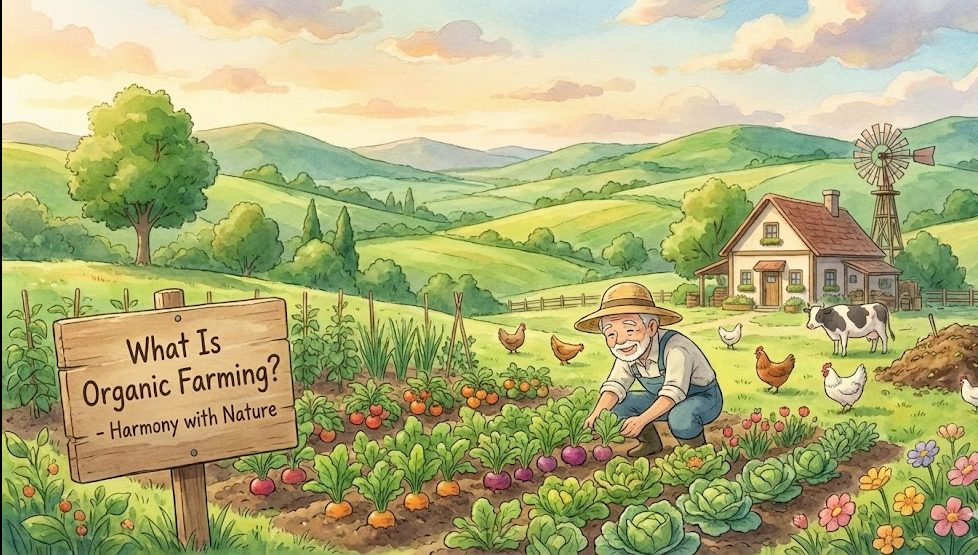
Organic farming is a natural method of agriculture that focuses on growing crops without using chemical fertilizers, pesticides, or synthetic inputs. It relies on nature-friendly practices that improve soil health and protect the environment.
This farming system helps farmers produce healthy food while reducing production costs in the long run. Organic farming also improves soil fertility, water quality, and biodiversity on the farm.
With increasing demand for chemical-free food, organic farming has become a profitable and sustainable option for small as well as large farmers. This guide explains organic farming step by step in simple language.
Overview of Organic Farming Crops
Organic farming can be practiced with vegetables, fruits, cereals, pulses, oilseeds, and spices. Almost every crop can be grown organically with proper planning and patience.
Organic crops usually grow a little slower than chemical crops, but they develop stronger roots and better resistance to pests. Yield becomes stable after the soil regains natural fertility.
Vegetables, pulses, and oilseeds are popular choices because they give regular income and good market demand under organic farming.
Soil Requirement and Land Suitability
Healthy soil is the backbone of organic farming. Soil should be well-drained, fertile, and rich in organic matter. Sandy loam or loam soil works best for most organic crops.
Soil pH between 6 and 7.5 is ideal. Before starting organic farming, chemical residues in the soil should be reduced by using compost and green manure.
Adding farmyard manure, vermicompost, and crop residues improves soil structure and water holding capacity naturally.
Farm Layout and Crop Planning
Proper farm planning is very important in organic farming. The field should be divided into blocks for crop rotation and easy management.
Growing different crops in different seasons reduces pest problems and maintains soil nutrients. Border crops and trap crops can be planted to protect main crops.
Compost pits, vermicompost units, and water channels should be planned inside the farm for smooth daily operations.
Seed Selection and Varieties
Always use high-quality, untreated seeds for organic farming. Certified organic seeds are best, but good local desi seeds can also be used.
Select crop varieties that are disease-resistant and suitable for local climate conditions. Local varieties often perform better in organic systems.
Seed treatment with cow urine, neem extract, or Trichoderma helps improve germination and protects seedlings naturally.
Land Preparation
Land preparation should focus on improving soil life instead of killing it. Deep plowing is avoided unless necessary.
Two light plowings followed by leveling are enough. Mix compost or well-rotted farmyard manure into the soil before sowing.
Green manure crops like sunhemp or dhaincha can be grown and mixed into the soil to improve fertility naturally.
Planting Method and Spacing
Correct planting method and spacing help crops grow healthy and reduce disease risk. Overcrowding should be avoided.
Line sowing is preferred because it allows easy weeding and better air circulation. Proper spacing ensures strong root development.
Organic farming focuses on balanced plant growth rather than forcing fast growth with chemicals.
Sunlight and Temperature Requirement
Most crops grown organically require proper sunlight for healthy growth. Vegetables need 4 to 8 hours of sunlight depending on the crop.
Temperature should match the crop season. Growing crops in their natural season reduces disease and pest attack.
Proper crop selection according to climate increases success rate in organic farming.
Irrigation Management
Water management plays a key role in organic farming. Over-irrigation can damage roots and reduce soil microbes.
Drip irrigation or light furrow irrigation is ideal. Water should be given based on soil moisture, not on fixed schedule.
Mulching with dry leaves or crop residue helps conserve moisture and improves soil health.
Organic and Natural Pest Control Methods
Organic farming avoids chemical pesticides completely. Pest control is done using natural and biological methods.
Neem oil spray, garlic-chili extract, and soap solution control most common pests. Regular field inspection helps detect problems early.
Healthy soil and balanced crops naturally reduce pest attacks over time.
Expected Yield and Approximate Earnings
In the first year, organic yield may be slightly lower than chemical farming. However, from the second or third year, yield becomes stable.
Organic produce usually gets 10–30 percent higher market price. Input cost is lower because expensive chemicals are not used.
Long-term profit increases as soil fertility improves and crop failure risk decreases.
Conclusion
Organic farming is a sustainable and farmer-friendly system that protects soil, water, and human health. It reduces dependency on chemicals and improves long-term farm productivity.
With proper planning, good seed selection, natural pest control, and patience, farmers can earn stable income through organic farming. Healthy soil ensures healthy crops and secure future generations.
Organic farming is not just a farming method—it is an investment in long-term profitability, soil health, and environmental balance.